
Lewis and Clark: Heading upstream into history, Part 1
If you love history, we are seeking comments and sponsors to support this column. Please email news@santafetimesnews.com for details.

For “empire-building” countries, the name of the game in the 1700s and early 1800s was exploration and colonization. France had become one of the most active at both. Napoleon was waltzing through his continent collecting European thrones like they were modern day baseball cards.

History tells us, in his 20 years of leading French troops, he had fought in 60 major battles, losing only eight. He was considered a tactical genius.

Napoleon’s goal of supremacy was going well, but it was expensive. His efforts to gain more and more territory was a classic example of, “biting off more than he could chew.”

President Thomas Jefferson knew the most important city in the expansion of the United States to own/control was New Orleans. France had acquired the city back from the Spanish, but they needed cash. The “Little Corporal” was willing to listen to proposals from US emissaries James Monroe and James Livingston about the city.

Napoleon, the land conqueror, had only one fear..the British Navy. Outgunned and outmanned on the sea, he knew another all-out war with Britain was imminent.

The United States needed and wanted to remain neutral in the upcoming war but was closer to France because of Britain’s continued “poaching” of British born American sailors at sea.

Instead of selling just the port city of New Orleans to the emissaries, Napoleon was willing to give up his dream for a western satellite country by offering France’s entire 828,000 square mile holdings in North America, the Louisiana Territory.

Monroe and Livingston jumped at the opportunity with Jefferson’s support; funding for the 15 million dollar purchase was to be worked out. This land mass would nearly double the size of the United States.

With details eventually completed and the purchase finalized… now what? It’s time to see what Jefferson bought.

The Spanish and French had been traversing the area mostly along the rivers since the 1500s, trapping, hunting, building small forts and trading with local Indians. Now it was the United States’ turn to study the territory, properly mapping and finding the best way to commercially exploit the vast area…that would become their immense task.

President Thomas Jefferson picked Captain Meriwether Lewis to lead the expedition: “Your mission is to explore the Missouri River & such principal stream of it by its course and communicate with the waters of the Pacific Ocean, whether the Columbia, Oregon, Colorado or any other river may offer the most direct & practical water communication across this continent for the purpose of commerce.” Don’t you love the way educated people wrote and spoke back then.

Lewis invited William Clark to join the expedition and share the command. Each providing specific knowledge and expertise to the venture.

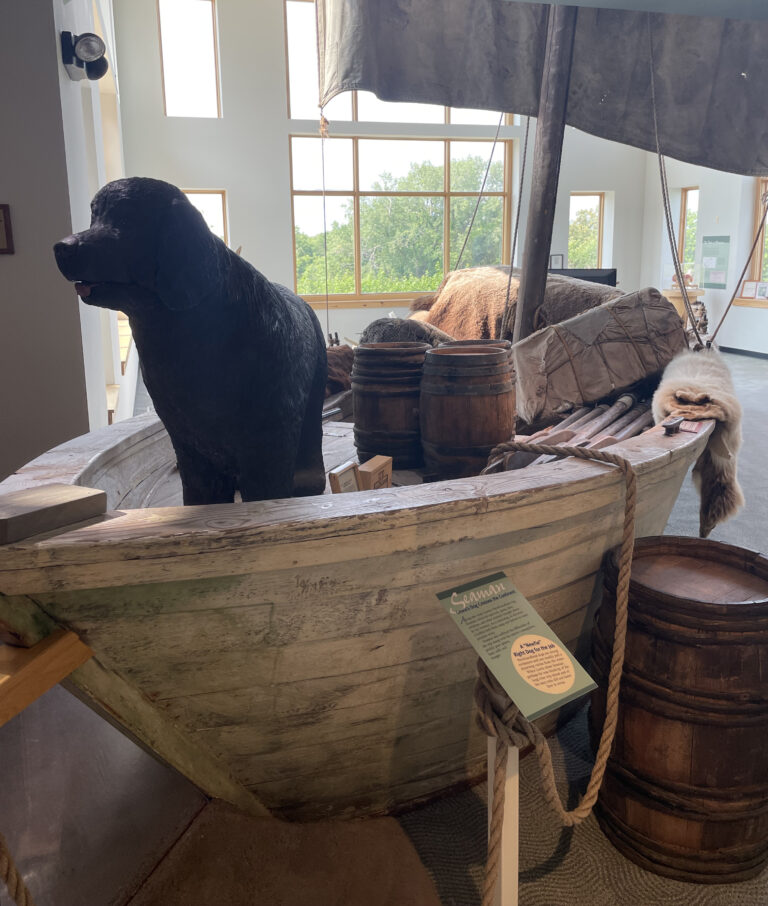
Dubbed the Corps of Discovery, the expedition recruited 44 unmarried, rugged men of diverse backgrounds along with a Newfoundland dog named Seaman.

It’s thought Lewis named the dog. Everyone knows the best way to find a name for a dog is to stand on your front stoop and shout a potential name as loud as you can three times, if the police don’t come and your neighbors don’t complain you have a fine name, but… On May 14, 1804, the Corps headed up the Missouri River and into history. With a keel boat and two smaller pirogues vessels, the expedition would average five to 20 miles per day, against the current. What made this adventure different from previous excursions was the detailed maps and journals kept, along with new species of plants and animals discovered then recorded.

The 2.5 year round trip was arduous… “Indians,” weather, insects, isolation, the terrain, starvation, injuries and illnesses challenged the men and Seaman too.

If the Corp of Discovery exploits spurs your curiosity, take a trip to Nebraska City, Neb., and visit with Doug Friedli, the Executive Director of the Missouri River Basin, Lewis and Clark Center. It’s a beautiful museum in the bluffs overlooking the Missouri River valley close to where the expedition camped.

One of the more interesting encounters for the explorers heading west was with Sacagawea, a Shoshone woman who, in her teens with child, helped and perhaps saved the Corps from attack and starvation. She joins the ranks of early American women who made a difference in the history of the United States.

The Corps of Discovery achieved an incredible feat that expanded knowledge of our country and initiated the largest peacetime migration ever known to mankind.

Their efforts and discoveries awakened a young nation and its citizens to the potential within us all. The point of this article is to remind us of, as a people, what we went through, how we got here and hopefully does leave you wanting to know more.

We salute the brave men and woman who risked their lives in search of, “what’s out there?”

You can find more of Bob’s work on his website, bobfordshistory. com also check out his YouTube videos under Bob Ford’s History.