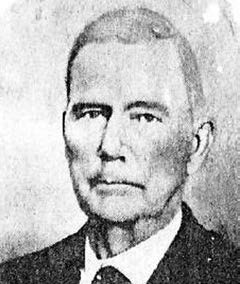
Lexington’s first mayor rose from penniless orphan to judge

The story of Lexington’s first mayor, Judge Eldridge Burden, is an example of a man rising to prominence on the strength of his own merits and determination.
Burden was born in Nicholas County, Kentucky, on December 27, 1802, the youngest child of James and Mary (Brain) Burden of Virginia. His father was a soldier of the American Revolution and served, in company with his brother, Joel Burden, under Gen. George Washington. After the war Joel Burden settled at Philadelphia.
Eldridge’s parents died and left him — at the age of 7 — a penniless orphan. Governor Thomas Metcalf, of Kentucky, assumed his guardianship, and Eldridge was adopted as a member of the governor’s family, receiving from the teaching and example of his noble benefactor an ambition for usefulness, which distinguished his life thereafter.
Burden qualified himself to begin the study of law by laboring in his youth for the means with which to defray his expenses at school. He was educated at Transylvania University in Lexington, Kentucky, where he graduated with honors in 1833. The same year, Burden moved to Lexington, where he began an active law practice.
Burden was married on Oct. 26, 1837 to Miss Patsey Triplett Waddell, daughter of John T. Waddell, one of the founders of Lexington.
According to an 1881 history of Lafayette County, “Burden was an old line Whig, and found, when he settled in Lexington, only fifty members of his party to oppose an overwhelming Democratic majority in Lafayette County. In 1838 he entered the political arena as champion of the Whig cause in his section and in a few years enjoyed the satisfaction of seeing his party largely in the ascendancy. During the war, and since, he has affiliated with the Democratic party.”
Burden served eight years in the Missouri Legislature, from the session of 1842 at intervals until 1860, during which time he was thrice elected president of the State Bank at Lexington, on joint ballot of that Democratic body, over prominent candidates of the dominant party.
For 12 years he was judge of the Probate Court of his county, a court at that time of extensive jurisdiction, and served with marked ability, having but one appeal from his decisions.
During the Civil War, as an ardent Unionist, Burden declined the tendered appointment as judge of the Sixth Judicial Circuit, made by Gov. Gamble, because at the time he was under parole of honor from the Confederate government.
Burden was one of the originators and champions of the bill abolishing imprisonment for debt, and the success of that measure in Missouri was mainly attributed to his able efforts in its advocacy. In the halls of legislation and in the Federal and State courts, he was the compeer of Doniphan, Ryland, King, Rollins, Leonard, and other emiment men of the state.
Burden was a Mason, and a member of the Christian church. He was vice-president of the first horticultural society of Missouri, became Lexington’s first mayor in 1845, and served in many official capacities of a public nature. In fact, his history may be said to parallel the history of Lafayette County, for he was identified with every event of a political and municipal character.
The 1881 history continues, “Judge Burden, although past the meridian of life, is possessed of a vigorous constitution and great physical strength, remarkably well preserved by his temperate life and moral habits, eschewing the use of tobacco and ardent spirits. His judicial qualifications are of the first order, enabling him with comparative ease to follow the thread of law through all the subtleties of complicated legal questions.
“His life presents an example of more frequent occurance in our own ountry than any other, where men without the extraneous influences of wealth and high connections, by their unaided efforts raise themselves to the highest positions of honor, and acquire the esteem and confidence of their countrymen in consideration alone of their own intrinsic merits.
“In all walks of public life Judge Burden served his country with zealous fidelity, and expects to pass his remaining days with those among whom he has grown gray in honorable usefulness.”