McGarry inducted into CARB HoF

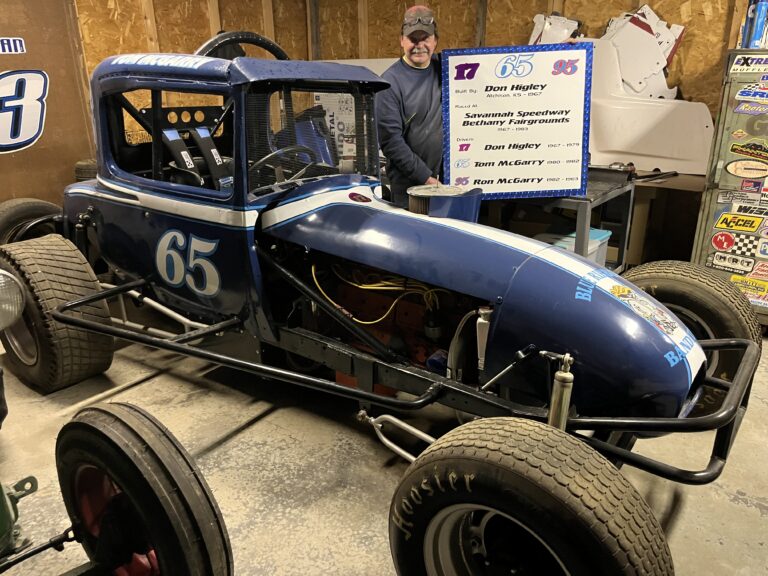
Forty-six years ago, Tom McGarry was a high school student just starting out his sprint racing career. It was a hobby that would continue throughout his lifetime; for about a dozen years he would race as a driver and for another 30+ years he would use his mechanical talents to help guide the team to victory.
After more than four decades of contributing to the sprint car scene, in late 2025 he was recognized for his dedication to the sport when he was inducted into the Central Auto Racing Boosters (CARB) Hall of Fame.
Tom’s introduction into racing began as a boy. His dad, John T. “Jack” or “Speed” Mc-Garry, was into racing, and he gave Tom the bug. “My dad was always associated with racing at Savannah Speedway,” Tom said. “He started back when he was right out of high school in the 50s. He started going up there [to the speedway] and hanging out with some of his friends; at that time the cars were called jalopies, now you’d call them modified stock cars. He helped a lot of different people in the late 50s and 60s. He never drove [in a race], but there was always a race car around the house that he was helping build or work on. He took me with him and I learned a lot just watching him.”
Speed McGarry was preparing to build his own car in 1960, but then he got married and his first son Ronald was born. His second son, Thomas, soon followed. By 1979 he had four children and was getting out of the race car scene. But he wouldn’t be gone long… within a year Speed McGarry would be back in the game, just in another capacity.
Tom McGarry’s very first race was at a track just north of his hometown of St. Joseph. The track, which no longer exists, was J&J Speedway located in Amazonia, Mo. It was 1980 and Tom had not even graduated high school yet, so his dad had to sign a release for him to race. Tom said if he wasn’t the youngest driver to ever race on that track, he was for sure very close to it. His parents, now divorced, were at odds: Mom wasn’t fond of the idea, but his dad was all for it.
“My dad backed me 100 percent,” Tom said. “He told me, ‘I’m not going to put you out there unsafe; I’ll get you the best safety gear and I’ll put you in a car that I know is safe.’” And with that, his foray into racing had begun. Meanwhile, Tom took a vo-tech class in high school and started learning to do machine work. His dad had a small shop where he learned more, and just down the road was a full-fledged machine shop, IM Machine & Fabrication. Tom would go there after school and hang out for several hours, sweeping floors and doing odd jobs. After high school he was hired on there full-time, essentially as an apprentice. He worked there from 19791993 and learned much of what he knows from that job.
Since his young beginnings, Tom’s sprint car career has stretched far and wide; he’s travelled to almost every track in Missouri, as well as competing in 12 other states and Canada. The journey includes a long list of highlights, as well as some scares.
The year after his first race, in 1981, Tom finished 5th in points at Savannah Speedway. That winter he also began to build his first car.
“Dad would come out and I’d show him where I wanted to put some part, and I’d ask him if that was the best position,” Tom recalled. “He’d tell me, ‘Well it’ll work there. Take it out and run it, and you’ll see.’ I had to learn on my own what was best. I had to cut that car apart so many times. He could have come in there as a dad and said, ‘This is how you do it,’ but then I wouldn’t have learned anything; I wouldn’t have learned how to make it better. He told me to learn your race car and know what it does, and I’ve tried to teach Matt [my son] that too. If you learn your car, you’ll always have an advantage over the next guy.”
In 1982 Tom won his very first race on opening night at Savannah. That year he placed 2nd in points at Savannah with the car he built and 1983 earned a points championship with 13 feature wins with that same car.
“I won 13 consecutive features in 1983, and set a track record with a sixcylinder that year,” Tom said. “1983 was my big year, and dad said, ‘You need to get out of here, you’ve accomplished about everything you can do.’ So after my third year at Savannah I started branching out to different tracks.”
In 1984 Tom earned the Most Improved Driver Award at the I-70 Speedway, a high-banked dirt track. That year he also met a cool girl, Joni, at the I-70 Speedway. She later travelled to watch him race in Kansas and as they say, the rest is history. The two would get married in 1989.
“She knew right from the beginning what I was into and she’s always supported me,” Tom said.
In 1985 Tom placed 3rd in points at I-70, and was Runner-Up for Rookie of the Year at Knoxville that same year.
Also in 1985 was one of Tom’s first big setbacks. During a race at Lakeside in Kansas City, Kan., his car caught fire. He knew there were many cars behind him so he couldn’t exit the track immediately, and the seconds cost him. By the time he was able to exit the car, he’d sustained serious burns on his face and hands. He was transported to a Kansas burn center and ended up needing skin grafts on his hands. Thankfully, Tom was wearing a uniform custom-made for him by Hinchman Indy Racing Uniforms, and that uniform saved him from much worse.
“Those uniforms have multiple layers and they come with a rating that tells you how many seconds you can be on fire before your skin will start burning,” Tom explained. His uniform was a year old, but it saved his legs. After the accident, his crew chief contacted the company that made the uniform, who requested it back for research. They sent Tom a new uniform free of charge and kept his burnt uniform for study and demonstrations. When they were done with it, they removed the ruined bottom half, hemmed the edge and sent it back to Tom as a keepsake.
In 1986 Tom had another accident, this one he described as the worst of them all. This accident occurred at I-70 Speedway and resulted in him being transported to Blue Springs with serious injuries, where he stayed for three days. The car was in such bad shape that the crew cut it up before he got home from the hospital. They didn’t even share any photos of it with Tom for fear that it might shake him up.
In 1987 he won the winged sprint in Savannah again, this time with eight feature wins. That same year he also set the one-lap track record at Savannah, which will remain in place as that track is now closed.
In 1988, he travelled every week over to Pleasanton, Kan., to compete at Linn Speedway. With five wins, he placed second place in points that year.
In the early 90s Tom was injured in another accident when his knees struck the steering gear of his car. Though he saw a doctor about it right away, he didn’t learn until nearly 10 years later that both of his kneecaps had been fractured.
In 1990, 1991 and 1992 he claimed track championships at the Northwest Missouri short track and also took second place in points in 1993.
Also in the early 90s, track promoters in Savannah began placing “bounties” on Tom, essentially paying a bonus for other drivers to come beat this guy.
“But then I would win anyway, so I got to keep the bounty,” Tom recalled, laughing. “I beat three different drivers who went on to be pretty great: Terry McCarl, Leonard Lee and Craig Dollansky.”
In 1993, Tom stepped back from driving and focused his efforts into the mechanics of the operation.
At that point he worked with drivers like Kevin Whitworth and Bryan Grimes, and the team would go on to win championships at US 36 Raceway, Lake Ozark Speedway and LA Raceway.
In 1993 Tom moved to Alma with plans to open his own machine shop. His boss and long-time supporter, Tom Leinen, owner of IM Machine & Fabrication, came down to offer advice before Tom made the final purchase. IM Fabrication remains one of Tom’s most faithful sprint car sponsors to this day.
In 2008 Tom picked back up some driving and in 2009 was points champion at LA Raceway.
In 2010, Tom experienced the same joy his father had back in 1980: He witnessed his son Matt drive in his first race. That race was held at LA Raceway when Matt was just 16, almost the exact same age Tom was in his first race. Tom had built the car Matt was driving, so he knew it was safe.
“It didn’t bother me, I was pretty excited for him,” Tom recalled. “I never really got nervous with him driving. Something my dad had told me was: You’re probably safer driving on that track than you are driving on the highway. So I didn’t worry.”
From 2011-2012 Tom raced alongside Matt at LA Raceway. The last time Tom drove in a race was 2014, and he didn’t even intend to race that day. He and the crew had been working on a new car with the intention of Matt driving, but the day of the race it was decided Tom would drive so that he could feel how the car handled.
In 2015, Tom handed the management reigns over to his son Matt Mc-Garry, but he continues to participate in the mechanical aspect of the team. Additionally, his daughter Megan does photography for the team and also helps Joni with the bookkeeping aspect — the whole family has committed to the dream.
“He still builds the chassis, does the chassisspecific setup stuff each race, all of the engine maintenance and drives the hauler,” Matt said. “[But] he gets to go have fun now and lets me worry about the money and stressful side. We bounce all of our ideas off one another and work pretty well together. It’s fun for me getting to enjoy doing it all together.”
Though this list is extensive, it’s not all inclusive. Tom, along with the M3 team, have won many more races and awards. And for Tom, the cherry was placed on top when, in 2025, he was inducted into the CARB Hall of Fame.
Tom was nominated by Dale McCarty, who is himself a 2015 CARB HoF inductee and who is an old friend of Speed McGarry. Tom said he’s known McCarty a long time; McCarty watched him grow up and grow into a well-recognized driver in the racing community. Nominations for this honor are reviewed by a committee that consists of all living CARB Hall of Fame inductees, the Hall of Fame board and nine additional individuals who are selected for their knowledge of racing history in Missouri and Kansas. The top eight nominees are then inducted into the HoF. The 2025 committee also inducted four Pioneers, who are outstanding individuals within the racing community who have passed.
Tom said this was his second time being nominated for the HoF induction, the first being about 10 years ago. When he found out he had been chosen from amongst the many other qualified candidates, he was honored.
“I knew they were talking about [nominating me],” Tom said, “But I was really surprised [to win]. I think it’s a prestigious award to get. Not everybody has it and to be able to be selected is special; they go by your criteria and take your statistics, there’s a nominating committee and also a selection committee to get through. It’s a lot.”
Tom was recognized for this achievement during a banquet held at Armacost Museum in Grandview on Saturday, Feb. 14, 2026. During the banquet, inductees received a plaque which read, “In honor of your contribution and distinguished dedication to the sport of oval track racing.”
Even with this achievement under his belt, there is no end in sight for Tom; he plans to stick with racing alongside his family.
“I love the competitiveness of it,” Tom said. “Being able to build a chassis from a pile of tubing, to put the car together and race out there and have your car be competitive in racing against the others. Not very many other people build their own cars, it’s kind of a pat on the back to watch your car win a race.”
“Everyone calls it a hobby, but I consider it a business,” he continued. “You have to set yourself a budget…sometimes things will break and you have to go outside your budget, other years everything is paid for easy. Like I’ve told Matt, you have to take the good with the bad and don’t ever quit. Just stay with it.”