The Battle of Wellington

Cold blooded killer or rebel with a cause?
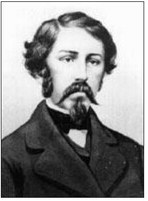
Missouri guerilla leader William Clarke Quantrill, who was mortally wounded near the end of the Civil War, remains a controversial figure to this day, and a mystery that will probably never be solved.
One historian noted, “He saved a lot more lives than people give him credit for. In fact, there were only two or three times when he rode up and shot someone. One was in Wellington, Mo., where he saw a horse a federal soldier had stolen from him and he waited across the street until the man came out of a store.”
According to “Young’s History of Lafayette County,” Quantrill made Lafayette County his headquarters for several years during the war.
He operated rather extensively in the western part of the county and in September, 1862, had a clash with the federal militia in Wellington.
The following is an account of the fight written by Charles M. Bowring: “On the morning of September 18, 1862, a company of thirty-three Federal militia under the command of Lieutenant Matt. Reid discovered some of Quantrill’s bushwhackers encamped on the banks of the Big Sniabar creek in the vicinity of where the Chicago & Alton railroad line is now located, just east of the residence of Robert Keene. There were but few men in the camp, the other members of the band being scattered out among the neighboring farmers, Quantrill with one of his men being at Keene’s for breakfast.
The Federals fired upon them and captured their camp. The noise of the firing aroused Quantrill’s scattered men, who quickly gathered in such force as to cause the Union troops to retreat hastily towards Wellington. They came on into town, leaving two men, James Crews and Neal Summers, on picket duty in the western part of the town. The others on reaching the main part of the village scattered in all directions among the citizens, seeking dinner.
They acted in a very careless manner, many of them even unsaddling their horses and turning them into stables or lots. Just at 12:30 P.M. Quantrill at the head of a column of about forty men was discovered coming up the Independence road at full speed with their hats off, hanging down their backs, suspended from strings around their necks, their long and disheveled hair streaming out on the wind, a revolver in each hand and with bridle reins in their teeth, forming in all anything but a reassuring picture to the astonished pickets, who at once fled headlong, shouting “Quant! Quant! Quant!” at every jump in energetic efforts to spread the alarm, their pursuers coming on with eager and terrific haste.
Quantrill’s men divided just west of the town, Quantrill himself with onehalf going north with the intention of getting into the river road and heading the militia off from Lexington, while the other half pressed straight ahead. By some mistake Quantrill took the wrong direction and came south up the hill, joining their comrades in the direct pursuit, thus leaving a route open for the retreat of the militia.
The full force thus united pursued the Federals on towards Lexington about four miles, the Federals making but one short turn just east of the Big Sniabar creek. During this pursuit, the pursuers kept up a constant fire.
On their return they burnt the bridge over the Big Sniabar creek. Quantrill rounded up his men on the public square, where an investigation revealed the fact that but one man had been hit, he receiving only a flesh wound in the upper part of the left arm.
As to the number of Federals killed in this affray, accounts vary. Dr. G. W. Love, the attending physician, then a resident of Wellington, says that three were killed outright in town, a fourth mortally wounded, who died twentyfour hours later in Lexington. One was killed just west of the ferry crossing to Wolf’s Island. One, Neal Summers, was killed at the lower end of Wolf’s island, his body being found in a clump of brush several days later. It is safe to estimate the total Federal loss at ten or twelve.
Only the names of George Williams, Neal Summers, W. and J. Powell and James Pointer are known positively. Williams and Pointer were both killed at the home of Peter Wolf, where they had stopped for dinner.
About four o’clock in the afternoon a command of three hundred Federal troops, under Major Burnette, reached Wellington from Lexington by way of the Warder ford on the Big Sni, who at first made dire threats of vengeance against the town and its people, but when they saw how carefully the wounded were cared for and the preparations for burial of the dead, relented and went on their way west after Quantrill. Conveyances came in from Lexington and carried off the dead and wounded and just how many of the wounded subsequently died was never clearly known.
Several members of the militia company were scattered over the village for dinner and were cut off by the furious charge of the bushwhackers through the place; some of these escaped by hiding in the cellars and some by slipping into the adjoining fields and hiding in the corn and hemp shocks. Several of them did not emerge from their hiding places for two or three days.”